
Argyle sweater
When and where was this item first created, and what practical purpose did it serve?
The argyle sweater originated in the early 17th century in the Argyll region of western Scotland, where the distinctive diamond pattern first appeared on clan tartan stockings and kilts. The Campbell clan of Argyll adopted this geometric design as their signature pattern, weaving it into woolen garments for both practical warmth and clan identification. Scottish knitters transformed the traditional tartan plaid into a more manageable diamond lattice pattern that could be easily reproduced in knitwear.
By the 1920s, the Duke of Windsor popularized argyle sweaters as golf attire, elevating this humble Scottish pattern into international fashion. The sweater’s practical purpose was twofold: providing warmth during outdoor activities while displaying sophisticated pattern work that demonstrated the wearer’s refined taste. Scottish manufacturers like Pringle of Scotland began mass-producing argyle sweaters for the growing leisure class.
The pattern’s mathematical precision appealed to the era’s fascination with Art Deco geometry and modern design principles. What started as clan identification evolved into a symbol of educated leisure, marking the wearer as someone who had both time and money for recreational pursuits like golf and tennis.
By the 1920s, the Duke of Windsor popularized argyle sweaters as golf attire, elevating this humble Scottish pattern into international fashion. The sweater’s practical purpose was twofold: providing warmth during outdoor activities while displaying sophisticated pattern work that demonstrated the wearer’s refined taste. Scottish manufacturers like Pringle of Scotland began mass-producing argyle sweaters for the growing leisure class.
The pattern’s mathematical precision appealed to the era’s fascination with Art Deco geometry and modern design principles. What started as clan identification evolved into a symbol of educated leisure, marking the wearer as someone who had both time and money for recreational pursuits like golf and tennis.
What are the key design features and construction methods of this item?
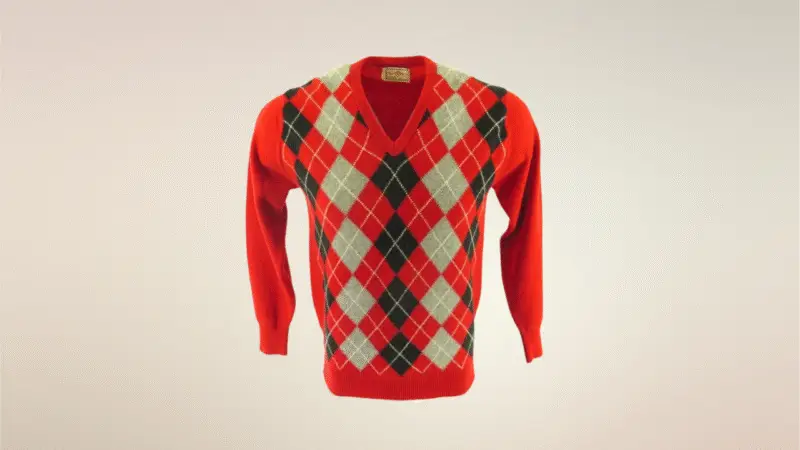
Authentic argyle sweaters feature intarsia knitting, where each colored section is knitted with separate yarn rather than carried across the back. The diamond shapes connect through thin diagonal lines that create the characteristic lattice effect. Traditional construction uses fine gauge wool knitting, typically 12-gauge or finer, creating a smooth, refined surface texture.
The diamonds should be proportionally balanced, usually measuring 2-3 inches across at their widest point. Classic color combinations include navy and white, burgundy and gray, or forest green and cream, always maintaining high contrast for pattern definition. The sweater body features set-in sleeves with properly shaped armholes and ribbed cuffs that maintain their elasticity.
Quality examples show consistent tension throughout the pattern work, with no puckering or pulling where colors change. The neckline traditionally features a simple crew neck or V-neck with matching ribbed trim. Shoulder seams align precisely with the wearer’s natural shoulder point.
The hem includes a substantial ribbed band that holds its shape over time. Interior construction shows clean color changes without loose threads or uneven gauge variations.
The diamonds should be proportionally balanced, usually measuring 2-3 inches across at their widest point. Classic color combinations include navy and white, burgundy and gray, or forest green and cream, always maintaining high contrast for pattern definition. The sweater body features set-in sleeves with properly shaped armholes and ribbed cuffs that maintain their elasticity.
Quality examples show consistent tension throughout the pattern work, with no puckering or pulling where colors change. The neckline traditionally features a simple crew neck or V-neck with matching ribbed trim. Shoulder seams align precisely with the wearer’s natural shoulder point.
The hem includes a substantial ribbed band that holds its shape over time. Interior construction shows clean color changes without loose threads or uneven gauge variations.
What cultural movements and social contexts featured this item?
The argyle sweater became the unofficial uniform of America’s emerging country club culture during the 1920s jazz age. F. Scott Fitzgerald immortalized the pattern in his descriptions of Princeton men and Long Island society gatherings.
The Duke of Windsor’s endorsement transformed argyle from Scottish heritage wear into international high fashion, making it essential attire for the leisure class. Jazz age women adopted cropped argyle sweaters as part of their rebellion against Victorian dress codes, pairing them with pleated skirts and T-bar shoes. The pattern symbolized the era’s fascination with geometric modernism and mathematical precision that defined Art Deco aesthetics.
Country clubs across America made argyle sweaters virtually mandatory for golf and tennis, creating an exclusive social uniform. By the late 1920s, collegiate culture embraced argyle as part of the “collegiate look” that defined campus fashion from Harvard to Stanford. The sweater represented a new American aristocracy based on education and leisure rather than birthright.
Hollywood stars wore argyle in films, cementing its association with sophistication and wealth. The stock market crash of 1929 only increased argyle’s appeal as a symbol of enduring class and refinement during uncertain times.
The Duke of Windsor’s endorsement transformed argyle from Scottish heritage wear into international high fashion, making it essential attire for the leisure class. Jazz age women adopted cropped argyle sweaters as part of their rebellion against Victorian dress codes, pairing them with pleated skirts and T-bar shoes. The pattern symbolized the era’s fascination with geometric modernism and mathematical precision that defined Art Deco aesthetics.
Country clubs across America made argyle sweaters virtually mandatory for golf and tennis, creating an exclusive social uniform. By the late 1920s, collegiate culture embraced argyle as part of the “collegiate look” that defined campus fashion from Harvard to Stanford. The sweater represented a new American aristocracy based on education and leisure rather than birthright.
Hollywood stars wore argyle in films, cementing its association with sophistication and wealth. The stock market crash of 1929 only increased argyle’s appeal as a symbol of enduring class and refinement during uncertain times.
Is this item still produced today, and how has it evolved over time?
Modern argyle sweaters continue production through luxury Scottish manufacturers like Pringle of Scotland and Ballantyne, maintaining traditional intarsia construction methods alongside contemporary interpretations. High-end fashion houses regularly reinterpret the pattern, from Thom Browne’s subversive preppy collections to Burberry’s heritage-inspired designs. Contemporary versions span from faithful reproductions using historical color palettes to avant-garde interpretations featuring neon colors and oversized diamonds.
The pattern has transcended gender boundaries, appearing in both menswear and womenswear collections worldwide. Mass market retailers produce machine-knitted versions that simulate the intarsia effect through jacquard knitting, making the style accessible to broader audiences. Technical innovations now include performance fabrics like merino wool blends and even synthetic materials for athletic wear applications.
The argyle pattern appears on everything from socks and vests to full cardigans and pullovers. Streetwear brands have appropriated the pattern for urban fashion, often scaling up the diamonds or using unexpected color combinations. Golf apparel continues to feature argyle as a nod to the pattern’s sporting heritage.
The pattern has transcended gender boundaries, appearing in both menswear and womenswear collections worldwide. Mass market retailers produce machine-knitted versions that simulate the intarsia effect through jacquard knitting, making the style accessible to broader audiences. Technical innovations now include performance fabrics like merino wool blends and even synthetic materials for athletic wear applications.
The argyle pattern appears on everything from socks and vests to full cardigans and pullovers. Streetwear brands have appropriated the pattern for urban fashion, often scaling up the diamonds or using unexpected color combinations. Golf apparel continues to feature argyle as a nod to the pattern’s sporting heritage.
How do you identify authentic vintage versions of this item?
Authentic vintage argyle sweaters display hand-linked seams where pieces connect invisibly, showing no visible stitching lines from the exterior. The intarsia knitting creates distinct color blocks without yarn carried across the back, resulting in a single-layer thickness throughout the pattern. Genuine pieces use natural wool fibers that develop a characteristic patina and softness with age, often showing slight felting in high-wear areas like cuffs and collar.
Pre-1960s examples feature moth holes in predictable locations, particularly around the shoulders and lower back where wool proteins concentrate. Original labels from manufacturers like Pringle of Scotland, Ballantyne, or Lord Jeff show period-appropriate fonts and construction details. The diamonds maintain perfect geometric proportions with sharp, clean color transitions that don’t blur or bleed.
Vintage pieces show natural shrinkage patterns, particularly in length, from decades of proper wool care. Authentic examples display subtle color fading in a uniform pattern, especially in lighter shades that were more susceptible to sunlight exposure. The ribbing maintains its structure despite age, showing quality elastic properties that synthetic reproductions cannot match.
Pre-1960s examples feature moth holes in predictable locations, particularly around the shoulders and lower back where wool proteins concentrate. Original labels from manufacturers like Pringle of Scotland, Ballantyne, or Lord Jeff show period-appropriate fonts and construction details. The diamonds maintain perfect geometric proportions with sharp, clean color transitions that don’t blur or bleed.
Vintage pieces show natural shrinkage patterns, particularly in length, from decades of proper wool care. Authentic examples display subtle color fading in a uniform pattern, especially in lighter shades that were more susceptible to sunlight exposure. The ribbing maintains its structure despite age, showing quality elastic properties that synthetic reproductions cannot match.